Session 0062 - Long Journey to Mror Holds
Roster
Player characters who's player is attending the game start with 1 Hero Point, and can get more during the session.
- 001-Alicia Silvermane: Matt
- 002-Eriana Valsarith: Morgan
- 003-Ferdinand Blackvenner: James
- 009-Harbek Fireforge: NPC
- 011-Hrovard: Malcolm
Absent
Player characters for missing players do not start the session with a hero point, and can not get any more during the session.
- 013-Rebar: Luke
Session Log
Before the party head out to the Mror holds, Harbek announces that he has enough personal resources to pay the travel expenses for everyone, provided they take the cheapest methods possible. He says it is the least he can do since he is the one dragging them all the way to his homeland.
This amounts to 220 gp and 7 sp, provided the party use up their two lightning rail tickets for traveling through Breland. The rest of the party are happy to accept his offer.
They set off on the morning of Therendor the 24th. The distance from Sharn to Frostmantle is approximately 2,500 miles as the crow flies (a distance roughly equivalent of traveling from Victoria BC to Quebec city QC, Canada). However, because the Mournland lies between Breland and the Mror Holds they must travel around it. The route they take is by lightning rail through Thrane, Aundair and Karrnath. As a result, they will end up traveling roughly twice that distance to get there.
It take the party a total of 17 days of travel; 8 days by lightning rail, 2 days on a galleon, and 7 days on foot and horse. They arrive in Frostmantle on the early afternoon of Eyre the 12th on a mildly cold snowy spring day.
During their trip Harbek takes the opportunity to tell the party a great deal about his kin and the land they are travelling to.
He begins with a little history of the dwarven people of the Mror Holds: Tol kollan! Some say our ancestors came from a place of ice, but we all know that’s nonsense. Our ancestors were the mountains themselves. The dragons were jealous of their mighty stature, so they cast a spell that put them all to sleep, and that’s where the mountains come from. We dwarves? We’re the sweat from their brow. Don’t believe me? Go take a look at the Face of Mror! No one could carve something like that, my friend; that’s the mountain’s original face. As for the others, well, they just went to sleep face down. That’s the tale I had from my father, and you wouldn’t want to call him a liar!
Harbek relates the following to the party during the course of their travels.
He begins by giving them a rough outline of the ages and significant periods in dwarven history:
Sol Udar: The Realm Below
Wherever the dwarves came from, they sunk their roots into the soil of Khorvaire. Dhakaani dirge singers sing of battles between dwarf and dar that took place in vast halls below the earth. Dhakaani records—which are more accurate than those of the dwarves—show that the Dhakaani encountered dwarves late in the golden age of the Dhakaani Empire and drove them east, eventually reaching a stalemate. The ancient dwarves lacked the numbers or resources to threaten Dhakaan, but they established a line below the Ironroot Mountains and held it against countless onslaughts. The dar had no need of the territory, and in time, decided the effort of conquest wasn’t worth the rewards. This was the origin of what the dwarves call Sol Udar, the Realm Below.
Mallanok: The Exile
The next major era in Mror history was Mallanok, the Exile. At some point—whether years or centuries later is unclear—a group of dwarven warriors were exiled from the Realm Below, and found a new home in the mountains above, along with their families and followers. The reason for the Exile depends on who you ask. Mroranon talespinners say King Mror of Sol Udar couldn’t decide which of his thirteen heirs should inherit his throne, so he pushed these heroes out onto the mountain to prove themselves worthy of his kingdom. The Soldorak say that King Mror was a weak tyrant, and he exiled the thirteen heroes because he feared an uprising. Professor Melian Mit Davandi of Korranberg has advanced the theory that the ancient dwarves may have exiled criminals to the surface world instead of maintaining prisons, and the founders of the Mror Holds were a broad assortment of criminals and undesirables. The truth is buried beneath the weight of thousands of years and may never be known.
Dul Krok: Bloody Stones
The Exile was followed by Dul Krok, Bloody Stones. When humanity came to Khorvaire, the Ironroot Mountains were divided between thirteen powerful clans of dwarves. These mountain dwarves were proud and warlike, but they were mired in feuds—and these ancient conflicts kept them from substantially advancing their culture or their influence in the world. Even as humans spread across the land, the dwarves continued to devote their energy and resources to their own ongoing vendettas. While they were unquestionably fierce warriors and made fine weapons, their deep division prevented any progress. The Ironroot dwarves weren’t the only dwarves on Khorvaire; some had spread east into what’s now the Lhazaar Principalities. It was largely these Lhazaar dwarves who integrated with humanity, spreading west with them, though there were also a few Mror who left their feuds behind to help build the foundations of the new kingdoms.
Bal Dulor: The Great Sorrow
As the Five Nations took form, humanity largely shunned the Ironroot Mountains and left the dwarves to their feuding. Following the rise of the united kingdom of Galifar, Prince Karrn finally made a concerted effort to pacify the mountain dwarves. This time is known as Bal Dulor, the Great Sorrow. The soldiers of Galifar were disciplined and took advantage of the existing feuds, isolating the clans or pitting them against one another. The central fortresses of the holds were impregnable, but Galifar held the surrounding lands; the compromise that followed left the dwarves as lords of their territories, but as subjects of Galifar, forced to pay tribute and taxes.
Korran Hal: Korran's Blessing
While the Great Sorrow was a source of deep shame to the dwarves, it brought a forced end to their violent feuds and forced them to raise the funds to pay their tribute. Warriors became miners, and the Ironroot Mountains proved to be an astonishingly rich source of mineral wealth. Mror talespinners say that the Sovereign Onatar had his forge in the mountains, and that Kol Korran kept his hoard beneath it; other scholars have speculated that there could be a more unsavory supernatural force at work, an overlord tied to greed bound beneath the peaks. Whatever the truth, this led to the period known as Korran Hal, Korran’s Blessing. Even with the taxes owed to Galifar, the Mror prospered and built a thriving society. While the ancient feuds were never forgotten, violence was no longer their first answer. The bearers of the Dragonmark of Warding, Clan Kundarak, were drawn into the Twelve and became House Kundarak. Working closely with House Sivis, Kundarak parleyed its wealth and the power of its dragonmark to establish the Banking Guild, and the influence of Kundarak helped to drive a further wave of cultural advancement.
Tra Halor: The Revelation
As the dwarves expanded their mines and fortress holds, they’d occasionally find tunnels and outposts that seemed to be tied to Sol Udar—outposts that appeared to have been abandoned many thousands of years ago. The dwarves continued to dig deeper toward the Realm Below, and this led to a wave of breakthroughs in the early tenth century, an event broadly known as tra Halor, the Revelation. Miners and masons found evidence of a vast, wondrous subterranean empire, with enormous city-halls below all of the modern holds. Early explorers found finely crafted treasures, along with evidence of even deeper mines and fortresses. It was clear that these cities had been built by dwarves, and it speaks to Mror character that rather than pondering the fate of the builders of this abandoned realm, the dwarves simply embraced this as a miraculous stroke of fortune and proof of their collective destiny.
Mror Solu: The Realms of Iron
By this time, the Last War was underway. For the last decade, Karrnath had been steadily raising taxes and demanding troop levies. But the dwarves were conquered long ago by Galifar, whereas Karrnath was just a piece of that broken kingdom. Inspired by Sol Udar and recognizing how far their people had come since the Great Sorrow, the lords of the holds convened in Mror Aulan, the Iron Council. The lords of the Iron Council affirmed their union and declared the sovereignty of Mror Solu—the Realms of Iron—a name which even the Mror themselves usually translate into Common as the Mror Holds. It’s worth noting that in calling themselves the Mror, dwarves aren’t professing fealty to Clan Mroranon or the ancient king of Sol Udar; rather, they’re simply calling themselves “the Ironfolk.”
Dol Udar: The War Below
The time that followed was initially known as Aul Aur, the Age of Gold. While Karrnath engaged in retaliatory actions during the Last War, it was struggling with famine and against its neighbors, and lacked the power to stop the rebellion. The dwarves expanded and explored Sol Udar, reclaiming wondrous relics and facilities. But soon they learned what had become of the ancient dwarves of the Realm Below, and why the kingdom had never reached up to the exiles. The ancient dwarves had been wiped out thousands of years ago by the daelkyr, for Sol Udar abutted on the demiplane prison of Dyrrn the Corruptor, one of the mightiest of the daelkyr. The first explorers found curious tools formed from flesh and bone—and then they discovered the creatures that made them. Dolgrim hordes rose from the depths. Entire colonies were lost and consumed by illithid corruption. While the Five Nations fought the Last War, the Mror fell into Dol Udar, the War Below, discussed in more detail later in “The Realm Below” section.
Today, the Mror Holds are in a stalemate against the aberrations below, and remain balanced between the Age of Gold and the War Below. Even with their current holdings, the dwarves continue to draw vast wealth from their mines. Clans take pride in the treasures reclaimed from the depths, and Mror artificers continue to learn from studying ancient artifacts. Though the dwarves are few in number, their economic power and strong fortifications have deterred any Karrnathi retribution, and no one challenged their recognition under the Treaty of Thronehold. The dwarves are proud and prosperous—and yet, old feuds linger. The Realm Below remains both a glorious lure and a deadly threat. And tensions are further exacerbated by the other treasures recovered from the depths—tools made not by dwarves, but by the daelkyr.
Harbek goes on to tell the party about the clans. He is a member of the Toldorath clan, as was his uncle the property is apparently tied to. Apparently the city of Frostmantle lies within the boundaries of clan Tordannon. He is a member of clan Toldorath and was raised in the city of Frosthaven. That city lies on the border between both clans, and is an important trade hub.
At a glance, Toldorath and Tordannon have much in common. They mine copper and herd mountain tribex and other beasts on the fields surrounding Mirror Lake. They’re stoic warriors when they must fight, but they never start a quarrel unless driven to it. In other ways, they are quite different. Tordannon dwarves are devoted to The Sovereign Host, while the Toldorath are ambivalent about religion. Tordannon suffered grievous losses in the War Below; they shun symbionts, have sealed off their deep passages, and live in fear of the next assault. In contrast, the Toldorath are intrigued by symbionts and keen to delve deeper into Sol Udar. Despite these differences, they support one another. Loyalty is one of the prime virtues of these clans—to family, clan, and the holds themselves.
One thing that unites these two clans is their support for the Jhorash'tar orcs. This is not a universal view among the other clans, and makes them stand out. Orcs can be found within their clan boundaries, and will likely be found in the city of Frostmantle where they are headed.
They finally arrive in Frostmantle on Eyre the 12th in the afternoon on a slightly snowy day with temperatures just below freezing. The party find a suitable inn called "The Stoutpick Rest", named for the ubiquitous mining pick carried by nearly every Mror dwarf. It is a practical, clean, no-nonsense inn with good food, strong drink, and beds built to withstand a raging barbarian.
That afternoon they set out to locate the official clan offices where they can inquire about the property claim. They find an official without much difficultly who directs them to a land titles officer. That person is somewhat helpful with various questions, but clearly becomes uncomfortable when Harbek begins to sense he isn't being told the whole truth about the property.
The officer does confirm the claim is legit, and that nobody else has laid claim to the inheritance. It is indeed tied to his uncle Welfast Brightblade, who was a part owner. Apparently the property was the rightful property of a human named Nigel Xarwin and it was he who put Welfast on the title. There were actually four people in total on the title most recently - Nigel Xarwin, Welfast Brightblade, Derek Warcaller, and Quaren Ael Drim. He is able to tell them about the lineage of the property, noting that the lands were purchased in 926 YK by Madreus Xarwin and the home completed in 926 YK. Apparently there are no building plans for the property, and official notes state that most builders disappeared upon completion.
Records show that Madreus Xarwin left the property on or around 941 YK and never returned. The property went to a heir in 945 YK. This was Ioseff Xarwin, and he moves in with his wife Asethanna where they raise two children. They live in the house until around 960 YK when tragedy strikes, and the family dies.
After this the property was abandoned for a few decades until it was claimed by a relative of Ioseff - a nephew by the name of Nigel Xarwin. Nigel claimed ownership and added his four friends shortly thereafter. Less than a year after obtaining the property, Nigel and his friends went on a trip south and never returned.
That was nearly 27 years ago, and he has long since been presumed lost or deceased. None of the named potential inheritors have claimed the property and Harbek is the last eligible individual. If he fails to claim the property the clan will retake the lands and buildings.
This person sticks to the facts and seems eager to have Harbek agree to the inheritance and complete the paperwork, but is unwilling to answer specific questions about why nobody else with a prior claim has come forward. Under pressure, official gets their manager who calls the party into a private office to discuss the matter.
Within the confines of the office, the dwarven manager is more forthcoming with information about the property. Under hushed tones, they learn that the reason it hasn't been claimed is because it is haunted. The manager blames it on a Tairnadel Elf historic site on the property. Local dwarves think its cursed and want nothing to do with it. The site was haunted in the decades since Ioseff Xarwin was said to have murdered his family there (something the other official never mentioned). The nearby community in the suburbs has been long abandoned during this period, so the property is on its own for at least a mile beyond its walls.
Nigel Xarwin was eager to claim ownership and put the spirits to rest. By all accounts he did just that, and things in the area seemed to improve. However, he and his adventuring crew were called away on some other mission and left the property in the hands of several stewards. He hastily added his friends to the title and left. The stewards were instructed not to enter the building and await their return.
Less than two years after they left most of the custodians disappeared, and the few that did not abandoned their stewardship. The area once again seemed to become haunted and shunned by the locals. This is why nobody has claimed the property.
The manager adds that if it is not claimed they plan on completely destroying the area in the summer. He doesn't explain how, except that the clan intents to go in with a large force to make quick work of it.
To this he adds that the party have plenty of time to go and explore and see if they are interested, and above all cleanse the place and make it liveable. If they do that, Harbek can claim the inheritance. He is given some rusty keys to the place along with instructions on how to get there. It is several miles south of the city.
Before leaving, the party decide to spend a day or two in Frostmantle to research a bit more about Madreus Xarwin, Nigel Xarwin, and anything more about the manor.
They learn little about Madreus except that he was from Karrnath, but do find out that Nigel and his friends were reasonably renown adventurers back about three decades ago during the end of the great war. Nigel himself was apparently a devote follower of the Silver Flame. Harbek's uncle was a skilled fighter. Derek Warcaller was a part orc druid from the Eldeen Reaches, and Quaren Ael Drim was an elf mage.
The relationship between Ioseff and Madreus is not clear, but he and his wife also came from Karrnath to live on the property.
After gleaning what little they could, the party set off to examine the property on the morning of Eyre 14th. They leave on a clear cold morning, with temperatures just above freezing. The roads and lands are still well covered in snow.
The property is roughly five miles south of the city, and it takes them a little over two hours to find it on foot. As they were told, in the last leg of the trip they notice a number of long abandoned properties leading up to the estate.
It is hard to find the path, but they follow it through the snow to a rusty wrought iron gate. Tangles of blackberry vines weave through the gate's bars. A rusty metal coat of arms comprised of a series of overlapping circles, rings, and stars adorns the front of the gate. There is a 10-foot high well made stone wall connected to the gate that appears to encompass the property.
The party move counter-clockwise a short distance along the wall, finding evergreen trees to the east. After going a short distance, they turn back - everyone except Eriana. Instead, she chooses to follow the wall all the way around. She goes for a jog and runs around while the rest of the party head back to the fence.
It takes Eriana about a minute and a half to make the loop, finding the wall goes all the way around and is still in good condition. Indeed, the property is quite massive.
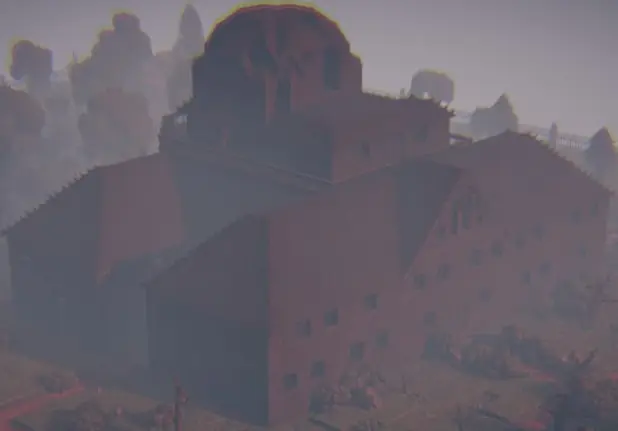
From the outside they can see the main building, which is located in the centre of the grounds. It looks quite large - perhaps 100-feet square with at least two main floors. There is a smaller third floor with a balcony circling the floor, and a much smaller fourth floor that appears to have no windows. The first three floors are covered with shuttered windows.
Even at this distance, there is one very odd feature - the entire roof of the building appears to be covered in swarms of small birds. They appear to be whippoorwills, or small brown birds.
Ferdinand examines the gate and tries to push it open but it doesn't budge. The blackberry vines seem to have it stuck. He pulls out a blade and cuts out the vines until he is able to push the gates open freely.
Once inside the group get a bit of a better view of the building. They notice there is an odd greyish/black film over the entire surface of the building - the walls, doors, windows, etc. It clearly looks unnatural, and only makes the presence of the birds seem all the more strange.